
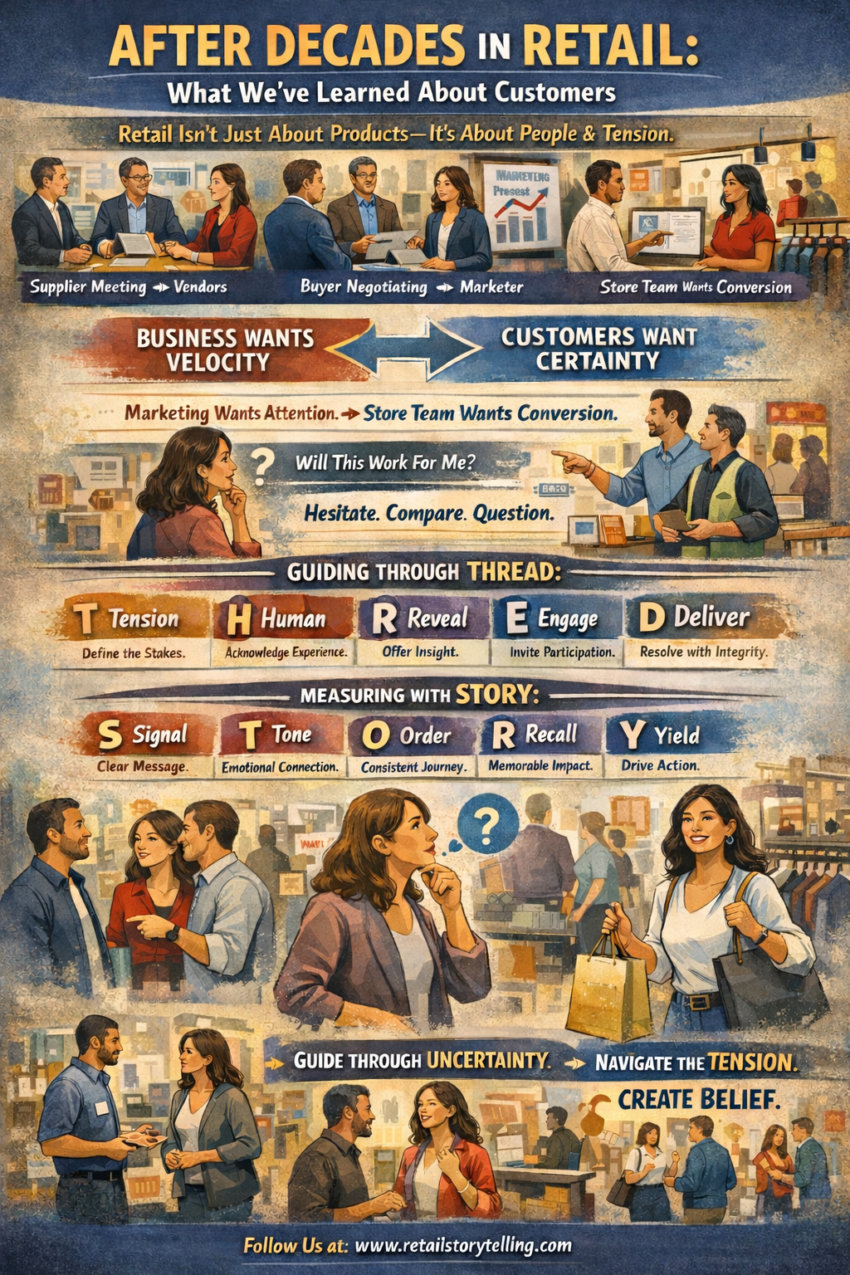
We’ve spent decades with retail customers.
→ With the vendors who sell to retailers.
→ With the buyers who negotiate with those vendors.
→ With the advertising and marketing teams asked to make the goods desirable.
→ And with the store teams trying to move those goods to customers the best they can.
We’ve seen what happens.
→ What people want.
→ How they react.
→ Where things break down.
And after all those years, some things have become clear:
→ Retail doesn’t only have a product problem.
→ It also has a tension problem.
Every retail environment contains a quiet conflict.
→ The business wants velocity.
→ The customer wants certainty.
→ The buyer wants margin.
→ Marketing wants attention.
→ The store team wants conversion.
→ The customer wants confidence.
That tension is not dysfunction.
→ It’s the story.
But most retail systems treat tension as something to eliminate.
→ “Reduce friction.”
→ “Streamline the path.”
→ “Make it seamless.”
Seamless sounds efficient until everything becomes forgettable.
→ Because without tension, there is no engagement.
→ And without engagement, there is no meaning.
Over time, we can begin to see a pattern.
→ Customers hesitate for a reason.
→ They compare for a reason.
→ They question for a reason.
They are not being difficult.
→ They are navigating risk.
→ Will this product solve my problem?
→ Will I regret this decision?
→ Can I trust this brand?
→ Is this worth the money?
Those questions are not barriers to the sale.
→ They are the emotional arc of the sale.
→ When retailers rush past that arc, they reduce the experience to transaction.
→ When they guide customers through it, they create belief.
That’s what led us to formalize something we had been observing for years. A framework we call THREAD.
THREAD is about guiding customers through meaningful friction:
T — Tension
→ Define what’s truly at stake.
H — Human
→ Acknowledge the lived experience behind the decision.
R — Reveal
→ Offer insight, not just information.
E — Engage
→ Invite participation instead of passive listening.
A — Anchor
→ Reinforce values and consistency across touchpoints.
D — Deliver
→ Resolve the story with integrity not just a transaction.
THREAD isn’t about scripting salespeople.
→ It’s about respecting the natural structure of decision-making.
Every purchase already contains:
Tension → Engagement → Resolution.
→ The question is whether we manage that arc intentionally or leave it to chance.
→ And once that story is told, it must be evaluated.
That’s where we use a second lens called STORY. A way to measure how well the narrative actually lands:
S — Signal
→ Is the story clear?
T — Tone
→ Does it connect emotionally?
O — Order
→ Is it consistent across every touchpoint?
R — Recall
→ Will it be remembered?
Y — Yield
→ Does it drive action without breaking trust?
After decades across vendors, buying groups, marketing teams, and store floors, this is what we know:
→ Retail is not about pushing goods.
→ It’s about guiding people through uncertainty.
→ The teams that win aren’t the ones who shout the loudest or discount the fastest.
→ It’s the ones who understand human tension inside every purchase.
→ It’s those who help resolve human tension with clarity, coherence, and integrity.
→ Loyalty doesn’t come from frictionless design.
→ It comes from friction well guided.