
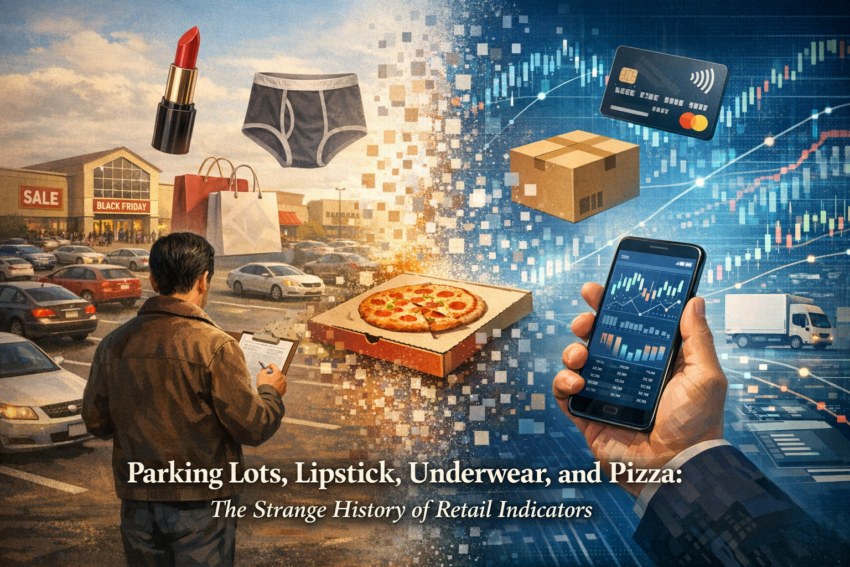
On a chilly Saturday morning in the late 1980s, a young retail researcher might have been found doing something that looked unusual. Clipboard in hand, he would stand at the edge of a suburban mall parking lot counting cars. To most people passing by, the activity would have seemed pointless. But to those trying to understand shopping trends, those cars represented something important: a real-time clue about the strength of consumer spending. Long before massive databases and real-time payment analytics existed, people studying the economy often relied on everyday observations. A crowded parking lot, a spike in lipstick sales, or a sudden surge in pizza deliveries could all be interpreted as hints about how people were spending money. Over time, several of these curious observations became well-known retail indicators. Some were serious attempts to understand consumer behavior, while others were more like cultural folklore. Among the most memorable were the Mall Traffic Indicator, the Lipstick Indicator, the Men’s Underwear Index, and even the trading-floor pizza signal. They were imperfect measures, sometimes humorous, occasionally insightful, and deeply revealing about how people once tried to understand the economy.
When the Mall Was the Center of Shopping
To understand why parking lots once mattered so much, it helps to remember how important shopping malls were in the late twentieth century. From the 1960s through the 1990s, suburban malls served as the primary shopping destination for many families. People often spent entire afternoons walking through climate-controlled corridors filled with clothing stores, electronics shops, jewelry counters, and food courts. At the heart of these complexes were large department stores. These companies acted as anchor tenants, occupying enormous buildings at the ends of malls and drawing shoppers inside. Once customers arrived, they often visited a variety of smaller retailers scattered throughout the complex. Department stores sold nearly everything a household might need: clothing, cosmetics, shoes, bedding, luggage, housewares, and gifts. Because of this wide range of products, activity at these stores often reflected the overall spending habits of middle-class households. If department stores were busy, it usually meant people were shopping confidently. If they were quiet, it could suggest that families were being more cautious with their money.
The Birth of the Mall Traffic Indicator
Out of this environment grew what people informally called the Mall Traffic Indicator. The idea was very simple: busy malls meant strong shopping activity. Researchers studying retail trends realized that by visiting stores and observing activity, they could often notice changes in shopping patterns before official sales numbers were released. During the 1980s and early 1990s, some observers developed routines that looked more like fieldwork than research. They would drive from mall to mall on weekends and record details such as:
- how full parking lots were
- how crowded entrances appeared
- how long checkout lines stretched
- whether stores were heavily discounting merchandise
The weeks leading up to Black Friday were especially important. Because retailers earned a large share of their annual sales during the holiday season, a busy mall in late November or early December often hinted at strong year-end shopping. Even small details mattered. A sudden increase in clearance signs or promotions might suggest that stores were trying to move unsold inventory.
From Parking Lots to Satellite Images
As technology improved, the Mall Traffic Indicator evolved in interesting ways. By the early 2000s, some research groups began purchasing satellite images of shopping mall parking lots. These images made it possible to estimate how many cars were parked outside malls on certain days. By comparing images week after week, researchers could track changes in customer traffic. The technique represented an early attempt to turn a simple observational idea into measurable data. For a period of time, it provided useful clues about retail activity. But the method had limits. Weather, seasonal patterns, and regional differences could all affect how full a parking lot looked. And eventually, the retail world itself began to change.
The Lipstick Indicator
While people were counting cars in mall parking lots, another unusual signal was emerging from the cosmetics industry. In the early 2000s, Leonard Lauder of Estée Lauder noticed an interesting pattern: during economic slowdowns, lipstick sales sometimes increased. The explanation had to do with human psychology. When people feel uncertain about money, they often delay large purchases such as expensive clothing or luxury items. However, they may still allow themselves small indulgences that bring a sense of comfort. A tube of lipstick is relatively inexpensive but can feel like a small treat. Because of this, rising lipstick sales were sometimes interpreted as a sign that people were cutting back on large expenses while still buying affordable luxuries. Although the pattern does not appear in every economic downturn, the idea became widely known as the Lipstick Indicator.
The Men’s Underwear Index
Another curious observation involves one of the most basic clothing items: men’s underwear. Former Federal Reserve chairman Alan Greenspan once pointed out that sales of men’s underwear sometimes decline during difficult economic periods. The reasoning is simple. Unlike jackets or shoes, underwear is rarely visible to others. Because of that, replacing it can easily be postponed. When households begin tightening their budgets, they may delay buying new underwear and continue wearing older items longer than usual. Companies such as Hanesbrands produce large quantities of these everyday products, and sales trends in this category have occasionally been viewed as a subtle signal of changing consumer behavior. The idea became informally known as the Men’s Underwear Index.
The Pizza Signal
Not all unusual indicators involve shopping habits. Some come from everyday work patterns. One long-running piece of financial folklore involves pizza deliveries during busy market days. When financial markets become extremely active, people working in financial centers often stay at their desks late into the evening. Leaving the office for dinner becomes difficult, so food is frequently delivered instead. Because of this, unusually high pizza orders from chains such as Domino’s Pizza and Pizza Hut have occasionally coincided with hectic periods in financial districts. While this “pizza signal” is mostly anecdotal, it reflects a simple reality: busy days often lead to more late-night food deliveries.
The Decline of the Mall Indicator
By the early 2010s, many of these observational indicators began losing their usefulness. The retail landscape was changing rapidly. Online shopping, led by companies like Amazon, was growing quickly and shifting purchases away from physical stores. At the same time, discount retailers such as TJX Companies expanded rapidly by offering brand-name merchandise at lower prices. Large warehouse retailers like Costco and major chains such as Walmart also captured a growing share of consumer spending. As these trends continued, activity inside malls no longer represented the full picture of shopping behavior. A parking lot might appear half empty even while online shopping was booming.
The Modern Era of Consumer Data
Today, understanding consumer behavior relies far more on digital information. Researchers can now analyze enormous streams of data, including:
- credit-card transactions
- online shopping statistics
- shipping and delivery volumes
- payment networks such as Visa and Mastercard
These tools make it possible to track spending patterns almost instantly. What once required visits to malls and observations of parking lots can now be measured through millions of digital transactions.
A Different Kind of Insight
Even though modern technology has replaced many of these older indicators, they still tell an interesting story about how people once tried to understand economic trends. Before the age of big data, observers often relied on simple details from everyday life. A crowded mall, a tube of lipstick, a postponed clothing purchase, or a late-night pizza delivery could all hint at deeper changes in consumer behavior. Today’s data systems may be far more sophisticated, but the basic curiosity remains the same: understanding how people spend their money and what those choices reveal about the world around them.