
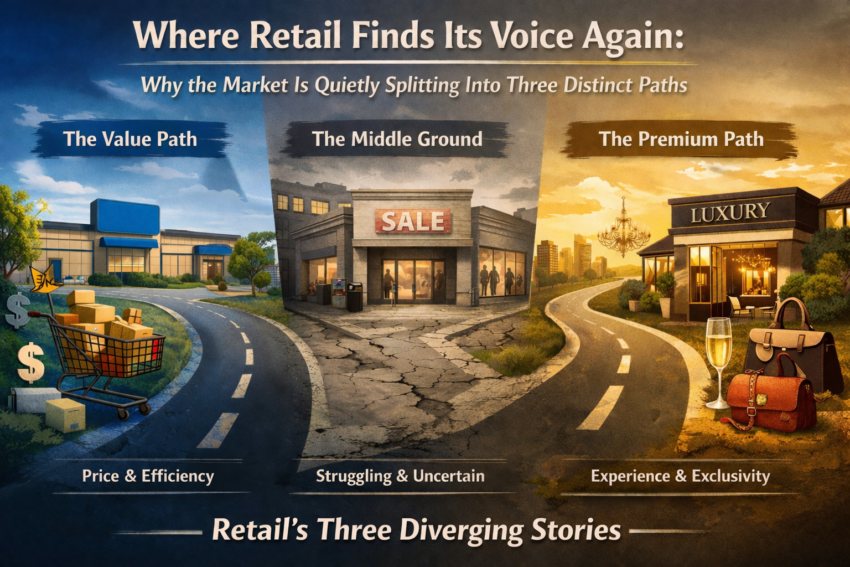
Retail isn’t disappearing. It isn’t even necessarily declining. What’s actually happening is more nuanced and more important. Retail is rediscovering its voice. And in doing so, is it separating into three very different narratives.
For decades, the industry operated in a relatively predictable middle. There was a broad, comfortable space where most retailers lived: not the cheapest, not the most premium, but “good enough” for a wide audience. That middle worked when consumers behaved in similar ways, when pricing bands were tighter, and when differentiation could be subtle.
That world is gone. Today, what we’re seeing across markets isn’t a collapse. Is it a split. Is it a structural realignment that is forcing every retailer to answer a much harder question:
What story are you really telling your customer? Because right now, there are only three stories that are clearly resonating.
1. The Efficiency Story: Precision, Discipline, and Everyday Relevance
At the efficiency end of the spectrum, retailers aren’t just competing on price. They’re mastering it. Companies like Walmart have moved far beyond the old perception of “cheap equals compromise.” What they’re delivering instead is confidence: clear pricing, strong quality control, and a sense that the customer is making a smart decision every time they shop.
Private label has played a massive role in this shift. It’s no longer the fallback. Kirkland has firmly established itself as a standout leader in the private label space. What makes it especially remarkable is the strength of its brand. Built on consistent quality, strong value, and a level of trust that resonates deeply with consumers. Kirkland has elevated itself to a point where it rivals, and often surpasses, national brands. It’s not just a store brand anymore; it’s a benchmark. Many are now trying to replicate its success, aiming to capture that same balance of quality perception and customer loyalty. In many ways, everyone else in the private label market is trying to become Kirkland.
In many categories, store brands now outperform national brands on both quality perception and value. But the real story here isn’t just lower prices. It’s operational excellence as a narrative. Every decision, assortment, supply chain, store layout, inventory turns. Is tightly controlled. The experience is consistent, predictable, and efficient. Customers know exactly what they’re getting, and in uncertain economic times, that reliability becomes incredibly powerful.
This is retail storytelling at its most disciplined: a promise kept over and over again.
2. The Premium Story: Emotion, Identity, and Experience
At the other end, something equally compelling is happening.
Premium retailers aren’t just holding their ground. They’re often accelerating. Luxury brands continue to perform because they’re not selling products in the traditional sense. They’re selling belonging. In this lane, price sensitivity behaves differently. The customer isn’t asking, “Is this affordable?” but rather, “Is this worth it?” That shift changes everything.
Stores become stages. Locations become strategic assets. Service becomes part of the product. Even scarcity. Real or perceived. Becomes a storytelling tool. The best premium retailers understand something that the industry once knew well: people don’t just buy things, they buy meaning. And when that meaning is clear, consistent, and emotionally resonant, it creates resilience. Even in uncertain markets.
This is retail storytelling at its most expressive: immersive, intentional, and deeply human.
3. The Middle: Where the Story Gets Lost
And then there’s the middle. This is where the pressure is most visible. And most unforgiving.
Traditional department stores, mid-tier apparel brands, and broadly positioned retailers are finding themselves in a difficult position. They’re often too expensive to compete with value players, but not distinctive enough to justify a premium. Historically, this segment thrived on scale, convenience, and brand familiarity. Names like Hudson’s Bay Company, Eaton’s, and even Sears (to some extent) once told powerful stories through assortment, in-store theatre, and cultural relevance.
They were, in many ways, the original storytellers. Walking into a great department store wasn’t just a transaction. It was discovery. It was aspiration. It was an experience that connected products into a larger narrative about lifestyle and possibility. But over time, that clarity blurred.
As retail became more standardized. And later, more digitized. Many of these players drifted toward sameness. Assortments widened but lost focus. Stores became more functional but less inspiring. The story weakened. And in today’s environment, a weak story is a dangerous place to be. Because customers are no longer browsing for “good enough.” They are making sharper, more intentional choices about where and why they spend.
What’s Actually Driving This Shift?
Several forces are accelerating this potential three-lane reality, but they all point to one underlying truth: retail is becoming more deliberate.
- Inflation, particularly in essentials like food and energy, is forcing consumers to prioritize with greater precision
- Profitability pressure is pushing retailers to focus less on expansion and more on execution
- Store strategies are evolving. Fewer locations, but better ones, with clearer roles
- Technology and AI are no longer optional—they’re becoming foundational to operational efficiency
But these are enablers, not the root cause. The deeper shift is behavioral. Customers are no longer passively receiving what retail offers. They’re actively choosing between clearly defined value systems.
This Isn’t a Cycle. It’s a Reset.
It’s tempting to view this as another retail cycle. Something that will rebalance over time. But this feels different. What we’re seeing is a structural reset in how retail competes and communicates. The middle doesn’t naturally refill anymore. It has to be re-earned with clarity, creativity, and conviction.
And that brings us back to storytelling. Not as a marketing layer, but as an operating system. Because the retailers that will win from here aren’t just choosing a price point. They’re choosing a narrative and aligning their entire business around it.
They will do one of three things exceptionally well:
- Be unmistakably the best value, through precision, scale, and trust
- Be undeniably premium, through brand, experience, and emotional connection
- Or be relentlessly efficient, executing so well that they create their own advantage
Anything in between. Anything unclear. Will continue to feel the pressure.
Retail hasn’t lost its way.
If anything, it’s returning to something it always understood at its best: That every shelf, every store, every decision tells a story. The difference now is that the audience is listening more carefully and choosing more decisively than ever before. It’s even worth asking a simpler question. Search “retail storytelling.” It’s everywhere. Why now?
Is it because endless scrolling and mouse-clicking are starting to feel like work? Is work-from-home slowly blending into shop-from-home and becoming just as tiring? We’re hearing it more and more: consumers, across age groups, are returning to physical stores. Not just to buy. But to experience something again. Maybe the story doesn’t need to be reinvented. Maybe it just needs to be told again.
I remember my parents bringing me to Saint-Catherine Street, Downtown Montreal. We would go up, down, nine floors of retail. Moving from one department to another. Years later, I brought my own children to those same stores. All of of them are gone now. What replaced them is, in many ways, impressive, highly efficient, optimized, frictionless. Built around the idea that our time is precious. And it is. But not always in the way we think. Because sometimes, spending time, wandering, discovering, even “wasting” a bit of it. Is exactly the point. That’s what great retail used to understand instinctively. And it’s what retailers are rediscovering.