Some brands use story in their marketing. The strongest retailers build their operations around it.
Retail storytelling is quietly gaining traction, and the retailers who embrace it are starting to see why!
Technology retail
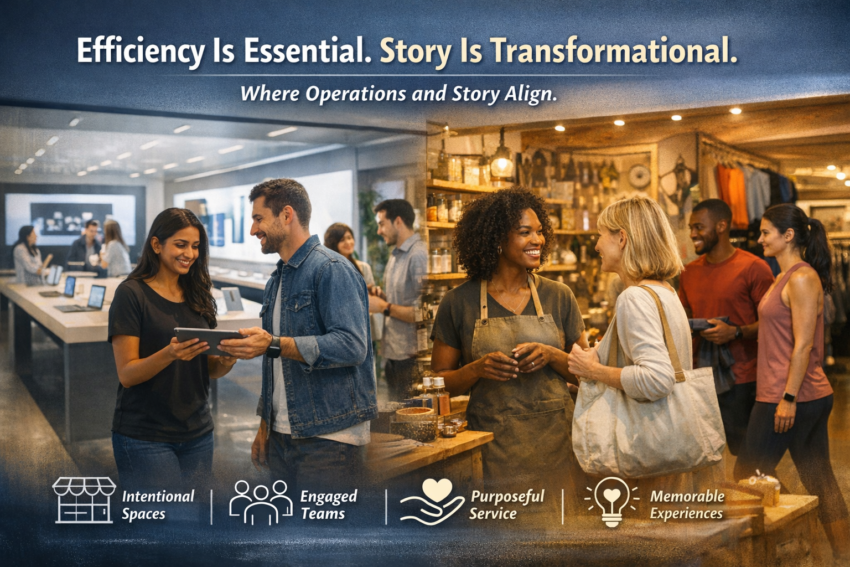
When the environment is stripped back. The language is intentional. Employees aren’t there to “sell”, they’re there to guide. The operational model reinforces creativity and empowerment at every touchpoint.
Performance apparel
The messaging is consistent: push further, break limits. But what’s interesting is how that narrative shows up operationally, in store design, athlete storytelling, product naming, community events. The brand promise isn’t sitting in an ad. It’s embedded in the system.
Outdoor retailers
They build around environmental conviction, repair programs, transparent sourcing, even encouraging customers to buy less. That’s not marketing. That’s alignment between belief and process.
Coffee chains
They dominate globally and didn’t win on caffeine alone. They engineered atmosphere, sound, language, layout, personalization. The story was belonging. The operations were designed to support lingering, not rushing.
Premium lifestyle brands.
Those giants created ambassadors instead of salespeople. Many premium labels design stores that feel like quiet rituals instead of high-volume transactions.
Different sectors. Different price points.
There’s a profound difference between telling a story in a campaign and embedding story into the way a business actually runs
You can feel it the moment you walk into a space where this is true.
→ The service feels natural, not scripted.
→ The team acts with clarity, not just compliance.
→ Nothing feels accidental.
That kind of alignment doesn’t happen because a poster in the back room lists brand values.
→ It happens because the narrative was defined first and then operationalized.
In some environments, the entire experience revolves around empowerment.
→ The physical space encourages exploration.
→ The team guides rather than pushes.
→ The systems support confidence.
In others, everything is built around performance and progress. Product presentation, language, imagery, and training all reinforce forward motion and capability.
→ Purpose-led retailers go further.
→ Policies reflect belief systems.
→ Sourcing decisions echo values.
→ Even what the company chooses not to sell becomes part of the story.
And in hospitality-driven formats, the atmosphere itself is engineered. Sound, lighting, pacing, personalization. All designed to create belonging rather than speed.
→ Different categories.
→ Different price points.
→ Different strategies.
→ Same principle.
→ Story precedes process.
When story is clear:
→ Training gains context.
→ Merchandising becomes narrative.
→ KPIs gain meaning.
→ Frontline teams understand the role they play.
When story is unclear:
→ Teams default to procedure.
→ Metrics become the goal.
→ Efficiency becomes the identity.
→ The experience becomes forgettable.
Operational excellence matters. It’s foundational. Clean stores, optimized labor, fast checkout, these are non-negotiable.
→ But on their own, they produce consistency.
→ Not connection.
→ Efficiency moves product.
→ Story moves people.
→ And loyalty is built in that space between the two.
The retailers who will lead in the coming decade won’t choose between operational discipline and narrative clarity.
→ They’ll integrate them.
→ Because the real competitive advantage isn’t just speed, scale, or technology.
→ It’s alignment.
The question isn’t:
→ “Do we have a brand story?”
The real question is:
→ Does every process, every policy, and every person inside the organization know how to deliver it?
And when the question is answered:
→ That’s when retail stops being transactional. And starts becoming transformational.