Half a century ago, Apple was born in a garage. Today, Apple powers how we work, play, communicate, and even think. Life without Apple is almost impossible to imagine.
Fifty years. A milestone few companies ever reach, and even fewer in ways that shape both culture and commerce. Reflecting on Apple’s journey takes me back to my own experiences on the retail and procurement side of technology.
In the mid-1990s, I was an IT buyer for two Montreal businesses selling Apple products. One focused on retail, the other serving institutional and educational markets. At the time, Apple wasn’t the cultural force it would later become. To most people, it was simply another technology brand: computers, printers, monitors, and software, sitting on shelves alongside other brands. But for those of us in the trenches, buying and selling these products, Apple was always different.
Procurement work in IT was methodical, detailed, and at times exhausting. We created purchase orders, checked sell-through reports, forecasted upcoming models, obtained approvals, evaluated margins, adjusted budgets, and repeated the cycle over and over. Every once in a while, a tap on the back for ordering a winner. Every once in a while, being shouted at for ordering too much inventory. The procurement life was meticulous, methodical, predictable. And very, very crazy at times.
And yet Apple somehow sometimes made the routine extraordinary. I remember attending a regional launch event for the Apple Newton. A handheld device that recognized handwriting? At the time, we weren’t sure whether it was brilliant or premature. Maybe a glimpse too far into the future. Back at the office, we returned to what we knew moved: the Macintosh Color Classic, the Macintosh LC, the Apple StyleWriter, the Apple LaserWriter, and even the PowerBook 100 and everything else that followed. Looking at some of those earlier units, they feel almost like a toys compared to today’s computers and other devices. Yet in its day, they were elegant, compact, and revolutionary in their own way.
I’ve only touched on a handful of products here. As a buyer, it was exciting to see new items before anyone else. Even the packaging was a step above other IT brands. Little was left out. Details mattered. The consumer, the student, the professional. Everyone experienced something when bringing an Apple product home and opening it for the first time. The unboxing itself was almost better than Christmas: the feel of the manual, the careful arrangement of accessories, the first power-on. Apple understood that purchasing a product wasn’t a simple transaction. It was the beginning of an experience.
I still remember the day the candy-colored iBook and the Power Macintosh G3 arrived. Store shelves that had always felt dull suddenly came alive. Shoppers stopped. Curiosity sparked conversations. Displays weren’t just functional; they were conversation starters. Technology felt personal, approachable. Apple had somehow made computers fun and people noticed.
Having nearly three decades in consumer electronics, IT, and major appliance procurement roles, I can still recall how Apple products connected with consumers back then. Long before anyone, myself included, had an inkling of what was coming next, we were seeing the beginning of a cultural shift. We focused on units, margins, and forecasts, yet Apple was quietly teaching a bigger lesson: products could be more than tools. They could tell stories, create experiences, and become part of someone’s life.
Every new release carried that signature feeling. I remember the Power Macintosh series and the Performa models, each with its distinct style, packaging, and usability. I remember the excitement of previewing the original iMac G3 before it hit store floors. Candy-colored, translucent. Even before customers touched them, we felt the shift. There was energy. There was curiosity. The products themselves spoke louder than any brochure.
Then came the iPod in 2001. Simple, elegant, intuitive. Apple wasn’t just a computer company anymore; it had become a lifestyle brand. Music, media, and technology blended into something entirely new. For someone working in procurement, the thrill wasn’t just in the specs or the margins. It was seeing people connect with products in ways that mattered: students discovering music on the go, professionals organizing their days with ease, families sharing playlists.
Another unforgettable moment was the iPhone 4. I remember walking into our small office to find one in its iconic white box on nearly every desk. That day, we traded in our other mobile devices without a word. Everything had changed. Phones weren’t just for calls or emails anymore; they were cameras, music players, calendars, entertainment centers, and portals into the digital world. The iPhone became a device that connected life, work, and culture all in one.
Over the years, Apple continued to teach lessons without ever saying a word. Each product, from the PowerBooks to the iMacs to the iPad, was a story waiting to unfold. And while I’ve only highlighted a handful here, each device carried the same DNA: meticulous design, excellent packaging, and the ability to create excitement.
Even today, I think back to the small details that mattered so much. The box, the manual, the accessories arranged just so. Apple understood that the first experience with a product was as important as its functionality. That understanding of experience over transaction set the company apart and kept it ahead of competitors for decades.
Fifty years later, Apple has gone from a garage startup to a company that shapes how the world works, learns, and plays. Its products touch nearly every aspect of daily life. Yet from those early days the attention to design, the excitement of opening a box, the feeling that this wasn’t just a tool but something special remains unmistakable.
Reflecting on that milestone, it’s fascinating to see what else has endured from the same era. The song Hotel California was also released in 1976. And fifty years later, its opening notes are instantly recognizable. Some creations are built to last.
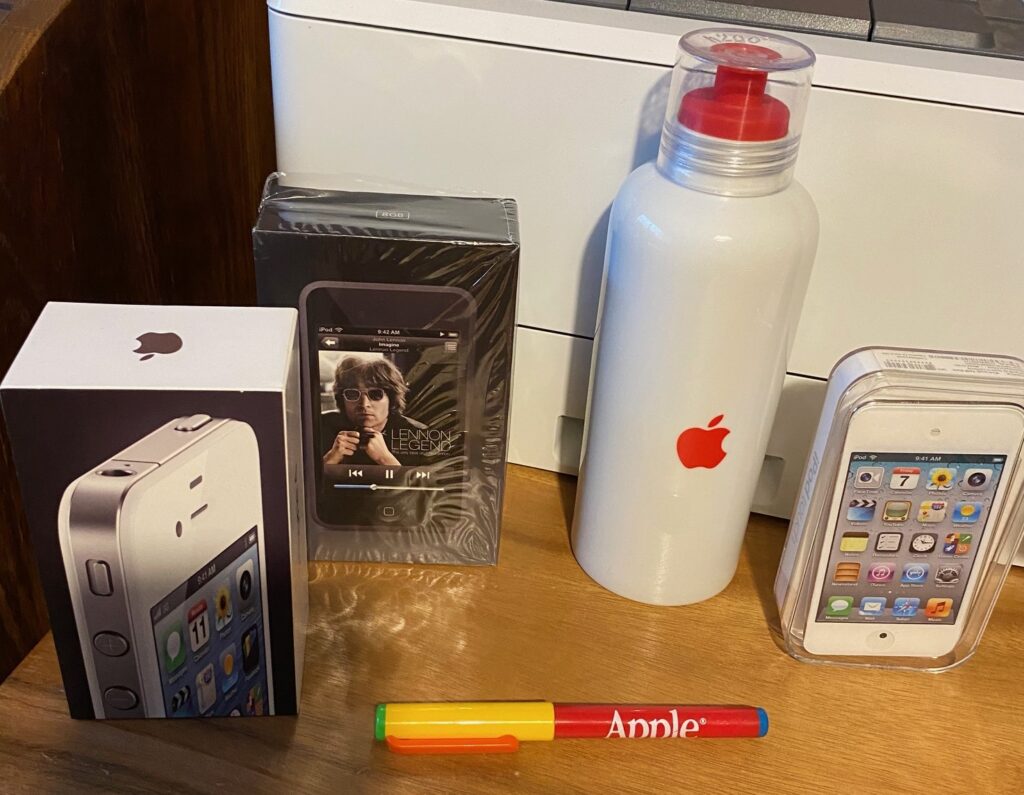
The image below shows a few pieces of Apple history I’ve held onto for decades: a ceramic Apple bottle I’ve had for nearly 30 years, a plastic Apple pen handed out at events, my first iPhone, and two iPods. Small objects, perhaps. But sometimes the smallest souvenirs carry the longest stories.
Looking back, it’s clear Apple was never just selling computers or gadgets. They were teaching all of us buyers, retailers, and consumers alike, a new way to think about technology. Products weren’t just tools; they were experiences. Every unboxing, every interaction, every moment became a story we carried home. And those stories, little by little, changed how the world interacts with technology.
Even now, thinking about those early experiences reminds me why Apple has lasted 50 years. Curiosity, excitement, connection. Apple turned products into moments, and moments into memories. Half a century on, Apple is still doing exactly that. And maybe that’s the secret to its longevity: creating experiences, not just products, that people return to. Over and over again.