The retail experiences weren’t unique. They were normal.
I’ve been to Italy many times. Once as a child, again as a teenager, and several times since the pandemic. One of those visits during the pandemic itself, in Bologna, not very far from where things were at their worst. What made those trips, especially the last few, meaningful wasn’t that I was a tourist discovering something new. It’s that I was participating in something ordinary.
In many markets, retail storytelling is something you add on. Campaigns. Signage. Designed journeys. A layer. In Italy, the story isn’t layered on top. It’s embedded in behavior. It lives in small decisions: how a product is presented, how a transaction unfolds, how time is treated. Not as something to compress, but something to respect. You see it immediately.
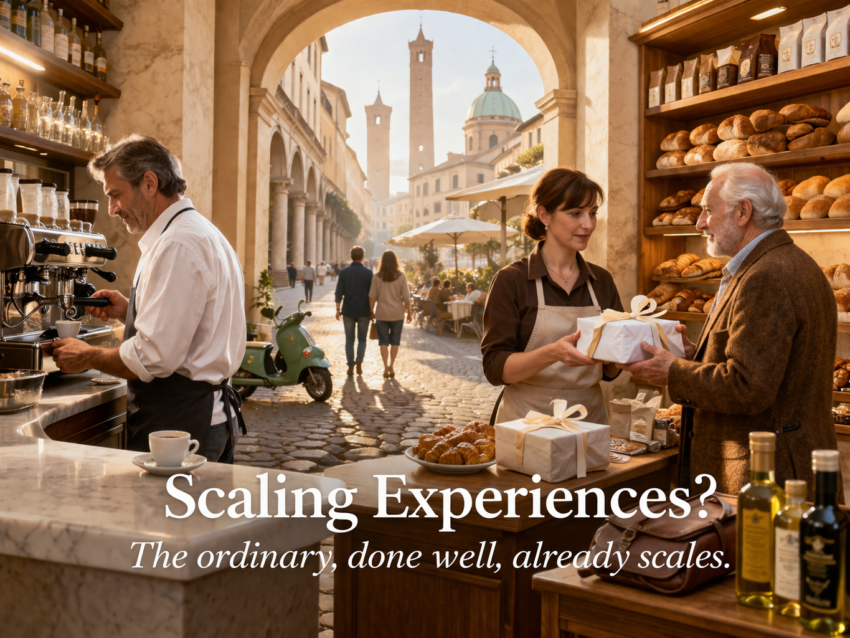
You get up in the morning and go for an espresso. It’s inexpensive, served in a real cup, prepared from freshly ground beans. No theatrics. No explanation. Just, precision, ritual. Normal. There is no separation between product and experience.
The espresso isn’t just coffee. It’s a moment of pause. Then you walk into a bakery. The baked goods are wrapped with the same level of attention you’d expect from an expensive piece of apparel. Not because it’s luxury, but because it matters. The wrapping isn’t packaging. It’s a signal. Intent. The shopkeeper isn’t performing hospitality. They’re expressing it as a default.
What’s striking. Especially over multiple visits. Is that nothing feels optimized for scale, and yet everything feels consistent. Not standardized. Principled. The story isn’t told through uniformity. It’s told through shared values. Quality isn’t announced. It’s assumed. Beauty isn’t reserved. It’s extended. Nothing feels inflated. Everything feels considered.
And yet, Italy produces brands and products that have scaled globally. Olive oil, cars, fashion. We know them quite well. They cross borders. They scale. But they don’t flatten. They don’t feel generic, even when they are everywhere. That’s not an accident.
My Retailstorytelling website, in many ways, follows this observation. What I saw, and how I saw retail while there. Not as standout moments, but as patterns. Behaviors that repeat so consistently they become invisible. Until you step back and realize they are the story. Retail storytelling, in that context, isn’t about differentiation. It’s about coherence. Every touch point reinforces the same idea: this is who we are, this is how we do things. And it doesn’t change depending on the price point or the customer.
So the real question is: Can that scale? Because for decades, we’ve assumed the opposite. That scale requires simplification. That growth requires stripping away nuance. That consistency comes from systems, not people. Italy suggests something else. Scale the principle. Not the execution. Don’t standardize every action. Standardize intent. You don’t script how to wrap the bread. You define what it looks like.
You don’t design a single perfect journey. You create conditions for good judgment to happen repeatedly. It’s slower to build. But once it exists, it compounds. The story no longer needs to be refreshed. It reinforces itself. And this is where modern retail starts to feel strained.
“As we’ve moved aggressively into e-commerce, there’s a growing sense of fatigue. Everything works. Everything is fast. Everything is optimized. And yet. Everything feels the same. Friction has been removed, but so has feeling.“
The pandemic accelerated all of this. We rushed into e-commerce. Into remote work. Into digital-first everything. Not always because we believed in it. But because we had to. And now, with a bit of distance, it’s a fair question: Did we trip and fall into a future we didn’t fully intend to build?
In optimizing for speed and convenience, we may have flattened the very things that make retail memorable. Ritual. Texture. Human inconsistency. Presence. The things that carry story don’t translate easily into grids and one-click checkouts.
“That doesn’t mean e-commerce is wrong. But it does mean it’s incomplete.“
The opportunity now isn’t to go backwards. It’s to rebuild forward. With better intent. What would digital retail look like if it carried the same principles as that espresso bar or neighborhood bakery? Not the aesthetic. The intent. Attention. Presence. Maybe we need to stop removing every moment of friction and start designing moments of pause. Maybe we need less uniformity. And more judgment.
Maybe the next evolution of scale isn’t about control. Because what those ordinary moments in Italy make clear is this: Storytelling isn’t fragile. It just needs the right conditions to exist. And scale doesn’t erase meaning. But it will. If meaning isn’t designed into the system from the beginning. Italy didn’t teach me how to make retail more impressive. It taught me how to make it more human. And that might be the only thing worth scaling.
I’ve spent decades in retail and institutional procurement, working alongside some of the best in the industry. What I share comes from lived experience. Long hours, seven days a week, being called out to customer locations, and constantly challenged by finance, marketing, logistics, store teams, and much more. In this world, past successes don’t carry weight; only current results matter. That’s what defines true retail expertise today.
Retail storytelling isn’t fluff. It’s a learned framework that brings all of this together. As technology and buzzwords dominate the conversation, experience still counts just as much in driving real results. Think of it as the modern version of the department store experience, before digital noise and the latest catchphrases took over. Where everything worked seamlessly across both the customer side and the operations side. That balance was what made it work. Now it’s coming back in a way that resonates with a new generation. At its core, it’s still about connecting product, people, and profits. But doing it in a way that feels real, relevant, and worth paying attention to.
There’s also a shift on the horizon which cannot be discounted. Consumers are getting smarter and more discerning. Businesses that label them as difficult are missing the point. The experience doesn’t need to be earth-shattering but it does need to focus on what truly matters. Department stores once understood this well. They faded as technology, mass marketing, and the pressure to move extremely large volumes of goods in new ways reshaped the industry. But underneath it all, the story, the connection between product, experience, and customer never disappeared.