The other day, I walked into my local grocery store to pick up my usual weekly staples, milk, eggs, bread, yogurt, and a few pantry refills. On the surface, it was an ordinary errand. Routine. Predictable. But in reality, it was something much more interesting.
Because it could have been any store.
A pharmacy. A bank branch. A clothing boutique. An online checkout page. A service counter.
I wasn’t just shopping, I was observing. I was testing THREAD in a real-world setting to see whether it truly reflects how people move through an experience.
It does.
The moment someone crosses the threshold of a store, physical or digital, THREAD begins.
They don’t walk in neutral. They walk in with tension.
They need something.
They are solving a problem.
They are spending money.
They are navigating time, uncertainty, and expectation.
That tension is the opening line of the story.
THREAD is a Retail Storytelling framework designed to transform what often feels like a series of disconnected operational steps into one cohesive, meaningful experience. Most organizations design processes. THREAD designs narrative flow.
It mirrors how human beings actually move through the world:
Emotion first.
Logic second.
Before price comparisons.
Before feature explanations.
Before policy details.
There is a feeling.
Will someone help me?
Will I find what I’m looking for?
Will this be easy or frustrating?
THREAD follows that emotional arc:
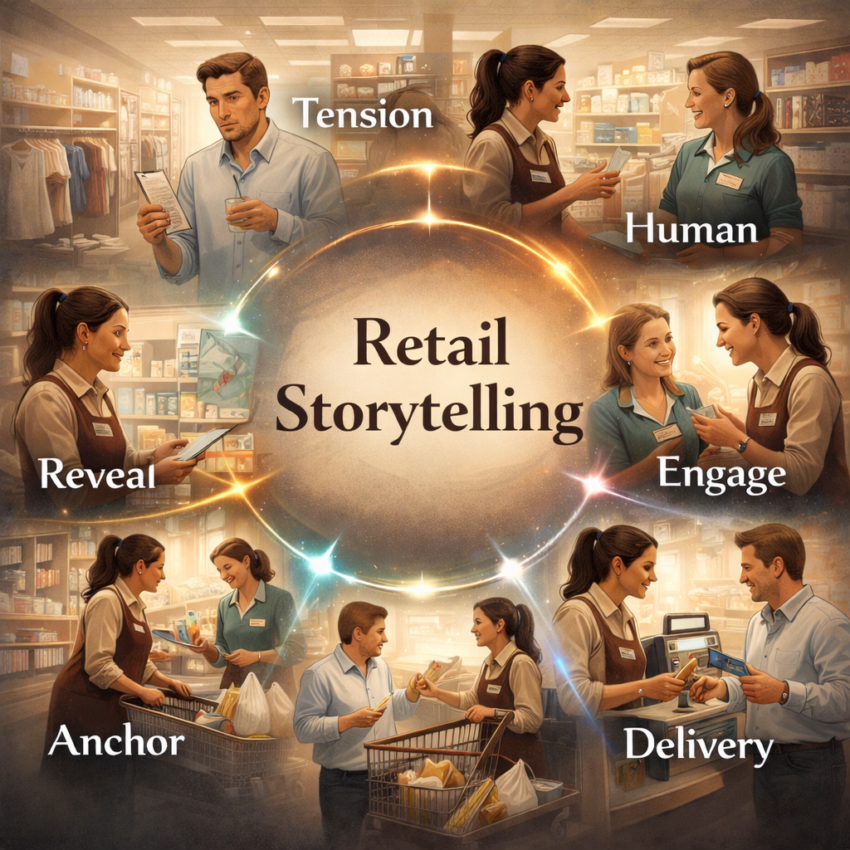
Tension → The reason they came.
Human → The presence (or absence) of someone who sees them.
Reveal → The moment clarity replaces confusion.
Engage → The active exchange of energy, attention, and dialogue.
Anchor → The stabilizing force that builds trust and confidence.
Delivery → The completion of the promise through transaction.
When these moments are aligned, the experience feels seamless. When they are not, it feels fragmented even if the transaction technically succeeds.
THREAD is not limited to retail.
It lives in banking, where a customer walks in uncertain about a mortgage decision.
It lives in insurance, where clarity reduces anxiety.
It lives in e-commerce, where design either guides or overwhelms.
It lives in education, healthcare, hospitality. Anywhere a person enters with a need and exits with an outcome.
THREAD works because it reflects something universal:
People don’t experience businesses in departments.
They experience them as stories.
And whether organizations intend to design that story or not it’s being written the moment someone walks through the door.
T = Tension
Let’s face it, it’s about friction.
Every story starts with tension. In retail, tension is the unmet need, the question, the curiosity, the friction. Tension creates attention. Without it, nothing else matters.
- Will this be easy or hard?
- Will I find what I need, or will I leave annoyed?
- That’s the tension customers often (or always) experience.
Tension shows up as:
- Confusion about where to start
- Uncertainty about options or price
- Time pressure
- Fear of making the wrong choice
- Sensory overload or dead space
- A problem that needs resolving
Tension isn’t a flaw. It’s the energy that pulls the customer into the experience.
H = Human
Will there be a human to help me or no one in sight?
Retail only works when it feels human. This is where empathy enters through language, design, staff, and behavior. Human is the moment brands stop talking at people and start connecting with them.
Human shows up as:
- Being seen, acknowledged, and not ignored
- Help that appears before frustration peaks
- Language that sounds like people, not policy
- Staff empowered to solve, not deflect
- Design that guides instead of confuses
- Small signals of care that reduce anxiety
- Respect for the customer’s time, mood, and context
Human is what turns a system into a relationship.
R = Reveal
Reveal is the moment of clarity.
The product, idea, or value isn’t pushed, it’s uncovered. This is where the story starts to make sense and trust is earned.
- Will something be revealed?
- Will this make sense to me?
Reveal happens when:
- Complexity becomes simple
- The right option distinguishes itself naturally
- Information is layered, not dumped
- The “why” becomes as clear as the “what”
- The customer feels smarter, not sold to
- Value feels discovered, not explained
Reveal is insight, not persuasion.
E = Engage
Do I engage, or do I tune out?
Engagement turns passive interest into participation. Touch. Try. Explore. Interact. Linger. Engage is where retail becomes experiential and where memory is formed.
Engage happens when:
- Customers are invited in, not pushed through
- Curiosity is rewarded with discovery
- Interaction feels optional, not forced
- The experience adapts to different levels of involvement
- People can move at their own pace
- Play, exploration, or personalization is possible
- The customer feels agency, not pressure
Engagement is not noise. It’s presence.
A = Anchor
Anchoring gives the story weight.
A reason to believe and a reason to remember. This is where meaning locks in, emotionally and cognitively, so the experience doesn’t disappear once the customer leaves.
- Will this stick?
- Will it mean anything once I leave?
- Has the experience anchored itself?
Anchors are created through:
- Emotional resonance
- Consistency between message and action
- A distinctive moment or ritual
- A clear belief or point of view
- Trust built through transparency
- Familiarity that feels earned, not generic
Anchor is what makes the experience stick.
D = Deliver (The Arc)
Delivery is not the sale. It’s the payoff.
The story completes its arc. The customer leaves with something tangible, emotional, or personal, and the story stays with them.
- I arrive with tension.
- I leave with a delivery.
Delivery includes:
- A clear sense of resolution
- Confidence in the decision made
- Relief replacing tension
- Value that feels earned, not extracted
- Follow-through after the transaction
- Consistency between promise and reality
- A reason to return or to recommend
Delivery is the moment the experience proves it was worth it. THREAD isn’t just retail. You feel it when you call your bank. When you deal with your insurance company. When you drop your child off at daycare. THREAD happens everywhere people interact with systems.
So why THREAD?
It moves beyond the funnel mindset, approaching retail as a story expressed through space, product, people, and behavior.
- THREAD doesn’t force conversion.
- It weaves connection.
- And conversion follows.
Try It
Walk into any store, call any customer service line, or login to any e-commerce site and notice:
- Where does tension begin?
- When does it ease or spike?
- Does a human appear at the right moment?
- Is something clearly revealed, or do you have to work for it?
- Are you invited to engage, or rushed to decide?
- What, if anything, anchors the experience?
- And when you leave, what was actually delivered?
If the THREAD can be followed end to end, the experience works. When it breaks, the system does too. Like any real thread, it starts on a spool, passes through a needle, and is pulled deliberately through every stitch until it becomes a finished piece of clothing. Miss a step, lose tension, or drop the threadand the garment fails. THREAD isn’t abstract. It’s already present in every interaction. The only question is whether it’s being designed with intent, or left to chance.